⚠️ Research Use Only. All information on this page is derived from published scientific literature and is provided strictly for educational and research reference purposes. Peptide Royalty does not provide medical advice. All cited findings are sourced from peer-reviewed publications as indicated. Nothing on this page should be construed as a health claim or recommendation for human use.

What is AOD-9604?

AOD-9604 is a synthetic peptide fragment derived from the C-terminus of the somatotropin sequence (fragment 176–191, with an added N-terminal Tyr). It is studied for its effects on lipolytic and anti-lipogenic pathways, Ξ²3-adrenergic signaling, and downstream pathway dynamics in laboratory and preclinical models.

Chemical Profile
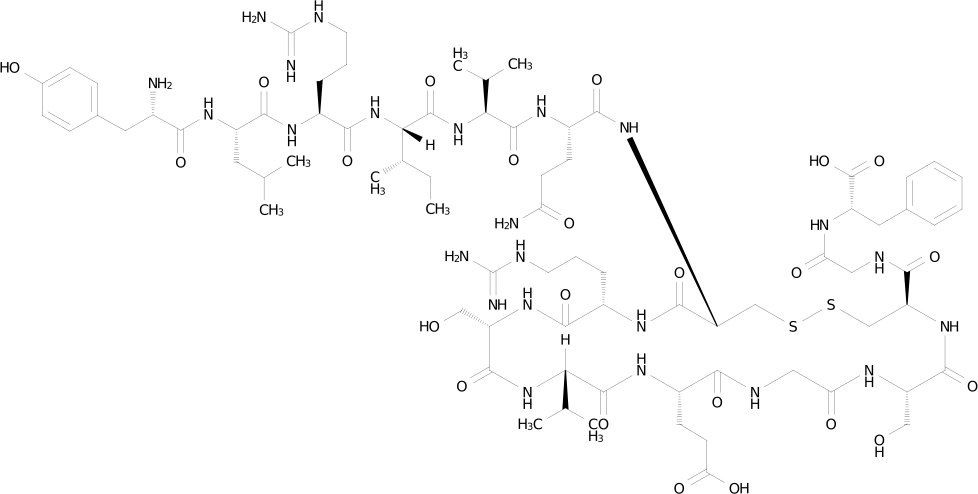
AOD-9604 molecular structure
CAS #: 386264-39-7
Molecular Formula: Cβ‚‡β‚ˆH₁₂₃N₂₃O₂₃Sβ‚‚
Molecular Weight: 1815.1 g/mol
PubChem ID: 71300630

Published Research Findings

The following findings are summarized from peer-reviewed literature cited in the References section below.

AOD-9604 has been studied in signaling, structural, and systemic models, with research exploring its effects on lipid pathway dynamics, substrate utilization, and remodeling processes. Studies also highlight its potential influence on cartilage modeling, skeletal signaling, and pathway activity in preclinical settings. Together, these findings suggest experimental potential across signaling, structural, and systemic pathways.

Key Areas Identified in the Literature:

Signaling: Lipid pathways, substrate dynamics, Ξ²3-adrenergic
Structural: Cartilage, skeletal matrix, connective tissue
Systemic: Remodeling, viability, metabolic pathway dynamics

References

All research findings on this page are derived from the following peer-reviewed publications. Peptide Royalty makes no independent claims β€” all statements are attributable to the cited authors and their respective studies.

Reference [1]
Heffernan M. et al. (2001)
Effects of hGH and its lipolytic fragment (AOD-9604) on lipid metabolism in obese and Ξ²3-AR knockout mice.
πŸ”— https://academic.oup.com/endo/article-abstract/142/12/5182/2988749
Reference [2]
Ng F.M. et al. (2000)
Metabolic studies of a synthetic lipolytic domain (AOD-9604) of human growth hormone.
πŸ”— https://downloads.regulations.gov/FDA-2024-N-4777-0009/attachment_5.pdf
Reference [3]
Stier H., Vos E., Kenley D. (2013)
Safety and tolerability of the hexadecapeptide AOD-9604 in humans: summary of randomized, double-blind, placebo-controlled trials.
πŸ”— https://jofem.org/index.php/jofem/article/view/157

Source AOD-9604 for Your Research

Laboratory tested Β· USA manufactured Β· COA available on every batch

Shop All Products β†’